

- The site about trombone playing!

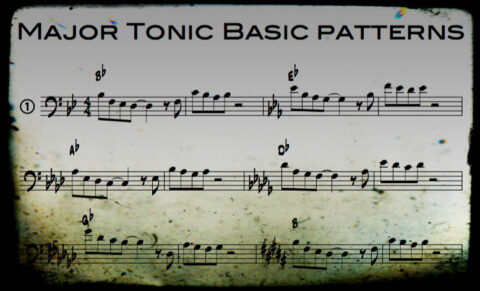
I stole this phrase from a Mike Stern recording a few years ago because I liked the sound of it. And bored on a rainy day, I decided to write it down in all keys and work on it on the trombone. It turned out to be a quite hard but rewarding technical trombone exercise. Try to play it as written, and you´ll get a good high range work out!

Enjoy…
read more »

I have written about the value of working with pedal tones before, but there is more to it! In these exercises, focus lays on including pedal tones when you work on flexibility on the trombone (or other brass instruments), and being able to access them effortless and without changing the embouchure to much compared to the normal range. read more »

Monday morning in the practice room? This is a great little exercise to get the chops going when you first pick up your horn that day. The key to all brass playing is in the air flow, and the key to a good air flow can often be found by working on a full, overtone rich sound in the medium to medium low range.

In this exercisee, I focus on F (below key hole-C) an augmented fourth down to B.* Many players have a hard time getting this register to sound as good as the rest of the middle range. One of the reasons is that the sound waves of the fifth in any given slide position doesn´t fit the instrument as goods as the fundamental on the same position (for example F versus Bb on 1st position). read more »

Practicing low range with a small mouthpiece
If you are working on the low range, consider doing the exercises you work on, on a smaller mouthpiece, or even on a smaller trombone if you play on a large bore tenor or bass trombone. Why? Well, playing a smaller mouthpiece makes it even more important to have the airflow centered in order to get the full sound. Big instruments and mouthpieces tend to be more forgiving if your embouchure and/or air flow isn´t dead on. You can test yourself: play a few notes in the low mid / low range in f on your large equipment. Now do the same with a smaller mouthpiece/trombone. Can you get the full sound out of it, or does it feels like it “locks up”? Of course, a big fff low E on a small bore horn with a 12C mouthpiece wont sound that great, but in general, you read more »

You might know the feeling, playing all those scale patterns one half tone up at the time… Seven keys to go ands the lips already feel as flexible as a train rail track!

There are lots of exercises where you gradually expand the range, and end up playing in either the extreme high or low register. I will give you a little but effective tip how to get the most out of those exercises, without busting your chops.

Expand from the middle
The solution is simple, make sure that you start in the middle range, and work your way both up and down from there. Mixing high and low range both save chops, and helps you to play with the same embouchure in all registers. This mouthpiece exercise works this way. read more »

Are you a jazz improviser? Do you know all the maj7 (major seven) and maj7#5 (major seven sharp five) patterns in all keys by heart? If not, I strongly recommend that you get started! They are extremely useful in when you improvise since they set the mood of a chord very clearly, and most of them are quite well suited for trombone as well.

The reason that I bring up the maj7 and the maj7#5 patterns at the same time, is because read more »

There is a lot of good music out there that has already been played! As a jazz player, you can of course take advantage of that and learn from the masters. Of course, transcribing jazz trombone players is a good place to start. There are many great players and even more great solos to dig in to! Transcribing solos played on your own instrument is smart, even if there might be some technically challenges, you know that it is playable on the instrument. Many times, you will find that what sounds really hip or hard, actually is quite logical on that specific instrument.
read more »

DOODLE TONGUING IN A JAZZ CONTEXT

In the previous articles in this series, I have talked about the fundamental of doodle tonguing, basic and advanced exercises. Doodle tongue is the perfect solution for all jazz trombone players who want to be able to play fast and precise legato lines.

This time I want to share some patterns and exercises that I have found to be very useful. This is stuff that I use a lot when I play improvised jazz solos. Let´s get started! read more »

BUILDING UP ON SPEED AND STRENGTH

Doodle tonguing is the perfect weapon for jazz trombone players who want to play fast and smooth melody lines. It is a technique for legato playing with built in swing phrasing!

Once you have the basics in place, and feel comfortable playing with doodle tongue, it is time to work on speed and strength. I use these exercises a lot, both to improving and maintaining my doodle skills. They are very useful, regardless if you just have begun mastering doodle tongue, or if you have been using the technique for centuries.

Use a metronome, and pick a tempo where you can play the exercises with great control and precision, and increase the tempo as you improve. Don´t to set the tempo too high! That might make you feel cool in the practice room, but you will sound bad on stage…

Playing these exercises is actually quite hard, and you will read more »

DOODLE TONGUING – BASIC EXERCISES
This is the second part of a series of articles about doodle tonguing, and this time I want to share a few basic exercises to improve both speed and precision when using doodle tongue.

I recommend that you take a few lessons with a doodling trombone player if you are new in this field to ensure that you get it right from the beginning. As usual, it is a lot easier to learn something the right way right away, rather than changing bad habits later!

The main use of doodle tongue is when you play fast legato lines, but to get there you should make sure that you can play it slow as well. The following exercises are all basic, and are designed to allow you to focus on getting the attacks perfect. read more »