- The site about trombone playing!

Monday morning in the practice room? This is a great little exercise to get the chops going when you first pick up your horn that day. The key to all brass playing is in the air flow, and the key to a good air flow can often be found by working on a full, overtone rich sound in the medium to medium low range.

In this exercisee, I focus on F (below key hole-C) an augmented fourth down to B.* Many players have a hard time getting this register to sound as good as the rest of the middle range. One of the reasons is that the sound waves of the fifth in any given slide position doesn´t fit the instrument as goods as the fundamental on the same position (for example F versus Bb on 1st position). read more »

Practicing low range with a small mouthpiece
If you are working on the low range, consider doing the exercises you work on, on a smaller mouthpiece, or even on a smaller trombone if you play on a large bore tenor or bass trombone. Why? Well, playing a smaller mouthpiece makes it even more important to have the airflow centered in order to get the full sound. Big instruments and mouthpieces tend to be more forgiving if your embouchure and/or air flow isn´t dead on. You can test yourself: play a few notes in the low mid / low range in f on your large equipment. Now do the same with a smaller mouthpiece/trombone. Can you get the full sound out of it, or does it feels like it “locks up”? Of course, a big fff low E on a small bore horn with a 12C mouthpiece wont sound that great, but in general, you read more »

You might know the feeling, playing all those scale patterns one half tone up at the time… Seven keys to go ands the lips already feel as flexible as a train rail track!

There are lots of exercises where you gradually expand the range, and end up playing in either the extreme high or low register. I will give you a little but effective tip how to get the most out of those exercises, without busting your chops.

Expand from the middle
The solution is simple, make sure that you start in the middle range, and work your way both up and down from there. Mixing high and low range both save chops, and helps you to play with the same embouchure in all registers. This mouthpiece exercise works this way. read more »

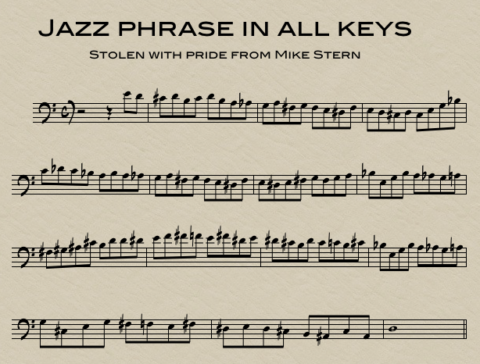
Are you a jazz improviser? Do you know all the maj7 (major seven) and maj7#5 (major seven sharp five) patterns in all keys by heart? If not, I strongly recommend that you get started! They are extremely useful in when you improvise since they set the mood of a chord very clearly, and most of them are quite well suited for trombone as well.

The reason that I bring up the maj7 and the maj7#5 patterns at the same time, is because read more »

DOODLE TONGUING IN A JAZZ CONTEXT

In the previous articles in this series, I have talked about the fundamental of doodle tonguing, basic and advanced exercises. Doodle tongue is the perfect solution for all jazz trombone players who want to be able to play fast and precise legato lines.

This time I want to share some patterns and exercises that I have found to be very useful. This is stuff that I use a lot when I play improvised jazz solos. Let´s get started! read more »

As far as I know, this is the first edition of Bach´s Cello Suites IN ALL KEYS! Now you can get Suite no 1 and Suite no 2 edited for brass in all keys, available in PDF format. With 120-152 pages each, there should be enough music to keep you busy for the rest of the week…and the next few years!

There are two versions available of each suite: high brass (treble clef) and low brass (bass clef). Since all keys are represented, it doesn´t matter how your instrument is tuned, there will always be plenty of well suited etudes for your instrument – trumpet, trombone, euphonium, tenor horn, alto horn, french horn or tuba. read more »

Have you ever tried to play Bach´s Cello Suites on trombone? Chances are great that you have, they sound fantastic and are quite well suited for trombone.

I use them a lot; for legato playing, intonation, building up chops and especially for pure pleasure! As a jazz player, my goal is not to make concert hall versions, and be 100% true to the original. I try to catch the flow good cello players have when they play the etudes, but otherwise, I just try to make them sound good on my horn. If they are new to you, find the download link at the end of this page, and enjoy Bach´s maybe most famous suite, no. 2 in D minor. read more »

Can you play a perfect crescendo in the middle/low range going from ppp to fff in one breath? This exercise is great to improve those skills!

But before you start playing the exercise in the sheet music gallery, please read the following:
The goal is not to play as strong as possible all the time! The goal is to get the feeling of opening up your throat and let the notes in ff pour out effortlessly.

The analogy of a water pouring out of a tap is a great way to visualize the air flow. Take a look at these three pictures: read more »

I know what you think: Yet another five minutes exercise that is supposed to change my life…
But no, this time you can actually settle with two or three minutes! And it really did make a big difference for me the first time I tried it, so I strongly recommend that you tried it out.

I got into some really bad problems with air flow a few years ago. After playing for years without thinking much about breathing with a natural talent for relaxed air flow I slowly got into trouble. It took me a very long time to get rid of the bad habits, both physically and mentally. This following exercise is one that really helped me. It is actually adapted from an excellent article about breathing problems (the Valsalva Maneuver) by Brad Howland.

I recommend that you stand up and make sure that you are relaxed and in good balance without your instrument. read more »

Admitted, this exercise is not the most fun you can have with a trombone, but there´s no way around the fact that there´s a lot of hard work involved if you want to be a top performer on a brass instrument. Footballers don´t kick a ball around all the time at practice…

With that in place: Let´s do something about the world of lip trills. Regardless of the genres you play, they will be needed at some point.

There is only one way to make it work, and that is to start slow. Find a metronome, and set a slow tempo that allows you to play the whole phrase. I recommend that you write down the tempo you can play it in today, and try to raise it by a few beats per minute every day over a period of time. The goal is to get to the point where you don´t notice the individual notes, and just let it flow. Think of it as running, you don´t want to think about every step you take, but rather just the direction and the speed. read more »