- The site about trombone playing!

There are a series of articles on Digitaltrombone about flexibility for brass players, and they all have their distinct advantages. Many trombone flexibility exercises tend to have a rather uninspiring rhythm and focus mainly on changing notes.

With these trombone exercises, I have added some rhythmical flavor, making them a bit more fun to play, but most of all, adding a new challenge to the concept of flexibility.

You should focus on playing these patterns as effortless as possible. Whenever you are changing note or changing from quarter notes to eight notes, think light and easy, rather than trying to nail it with force. More ballet, less sumo. read more »


How to improve your trombone playing with 5 minutes of theory (and a lot more practice…)
or
The only way to get to the next level of brass playing
or
Get that music-school-trombone-sound out of my life!!!
or
The truth about one of the worst and most common bad habits among brass players

Are you convinced that you continue reading this? Good, then let us get down to business! This post is about attack and tonguing for trombone players and ALL other brass players. This post is about how to discover one of the most common bad habits among brass players – and more important – how to get rid of it. read more »

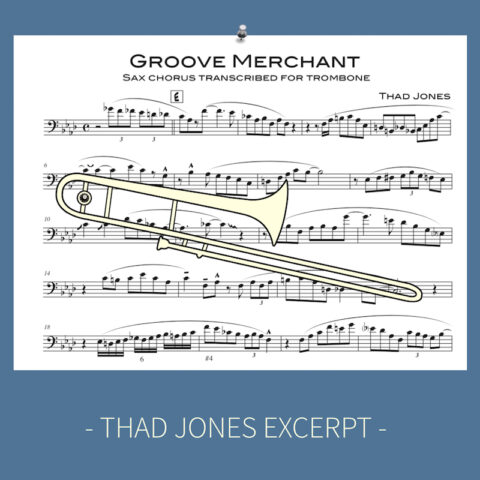
How come the saxes always get to play all the fun parts in big bands? Cool, beautiful and hip melody lines, accompanied by an occasional “bap” or “do-bauw” from the brass section. Ok, it is not the whole truth, but there are some fun sax parts that are (reasonably) playable on trombone as well. Do I need to say how good it will sound when played on trombone?

Thad Jones is known for his brilliant music for big band, and Groove Merchant is one of my favorites. Especially the sax chorus is amazing. Full-fat super-hip lines with intense voicings, this is Thad at his best! And even better, it is actually quite suited for trombone. Admitted, it is a bit technically challenging, but the range is spot on – when playing it an octave below the lead soprano. I wrote out the harmony as well, it´s a fun piece to solo on. read more »

It does´t matter if you are a jazz or classical player, you still want to make music. And you should still make music in your practice room. A really good way to get some music into your daily routine at an early stage, is to play some free improvisation. Again, it does not matter what genre you play, as a matter of fact, if you are a non-improviser I would say that this tip is even more important!

Here is what I want you to do:
Find a simple warm up exercise and play it for a few minutes, just to get some air through the horn. Then you play a totally free improvisation for five minutes. Just play, and see where it takes you! Don´t worry about stiff lips, bad sound ore any other detail that probably would distract you if you where playing your standard 4 pages of flexibility exercises.

“But I have never learned how to improvise!” No problem. Here is the key: read more »

Yet another flexibility exercise – seems to be that time of the year! These patterns show you some ways to get out of the first-down-to-seventh-position-playing-the-same-pattern-mode, making it more fun to play. This also makes your flexibility practicing come closer to the actual use of it in real music.

Many trombone (and other brass players) tend to do their flexibility home work, but as soon as they start moving the slide around, they put an attack on every note and cut up their airflow. Don´t go there! On of the benefits of flexibility exercises, is that it improves your legato playing – that is, if you actually use your flexibility skills. Both legato and flexibility should focus on constant air flow! read more »

Did you miss part 1 in this series? Read more here: Flexibility on trombone and mouthpiece – Part 1.

In this second part with exercises for both trombone and mouthpiece, the focus is on octaves and a mix of staccato and legato playing. The idea is to work on mouthpiece and trombone simultaneously to make sure that you use a similar embouchure. Beware of the pitch on the mouthpiece, especially when playing staccato phrases.

When a task is repeated over time, the muscle memory will be better and better at remembering how to do it, eventually allowing it to be performed without very much effort. This is important when playing on the mouthpiece since there is no tubing to “force” the lips to vibrate with the correct speed. You should combine this with using your ears to be able to hear the next pitch, before you play it.

By practicing the switch from mouthpiece to trombone, you will improve instrument control and your ability to hit the right pitch on the trombone.

The trick with playing on mouthpiece alone, is also to use the muscles at the side of the mouth where the lips meet, without creating tensions elsewhere in your body, disturbing the free air flow.

Good luck!


__________________________________________________________________________________


You will find this exercise and many others in the book Flexibility for Trombone – 38 pages in print friendly pdf format.

__________________________________________________________________________________

PS. Remember to sign up for the newsletter and get a free Jazz Etude! Find the sign up form at in the right column of the top of the page.

No secret for trombone and other brass players that practicing flexibility is one of the keys to good technique and chops! Playing the same exercise on both mouthpiece and instrument is great both for building up strength and gaining more control over the instrument.

Slightly re-inventing the wheel, I have made a bunch of trombone exercises that focus on playing both on the trombone and the mouthpiece. They are supposed to be played first on trombone and then on mouthpiece, but as a variation you could start with the mouthpiece. There will be some fiddling around with the mouthpiece on and off, but please bare with me on this one. read more »

I stole this phrase from a Mike Stern recording a few years ago because I liked the sound of it. And bored on a rainy day, I decided to write it down in all keys and work on it on the trombone. It turned out to be a quite hard but rewarding technical trombone exercise. Try to play it as written, and you´ll get a good high range work out!

Enjoy…
read more »

I have written about the value of working with pedal tones before, but there is more to it! In these exercises, focus lays on including pedal tones when you work on flexibility on the trombone (or other brass instruments), and being able to access them effortless and without changing the embouchure to much compared to the normal range. read more »

Monday morning in the practice room? This is a great little exercise to get the chops going when you first pick up your horn that day. The key to all brass playing is in the air flow, and the key to a good air flow can often be found by working on a full, overtone rich sound in the medium to medium low range.

In this exercisee, I focus on F (below key hole-C) an augmented fourth down to B.* Many players have a hard time getting this register to sound as good as the rest of the middle range. One of the reasons is that the sound waves of the fifth in any given slide position doesn´t fit the instrument as goods as the fundamental on the same position (for example F versus Bb on 1st position). read more »