- The site about trombone playing!

Are you a jazz improviser? Do you know all the maj7 (major seven) and maj7#5 (major seven sharp five) patterns in all keys by heart? If not, I strongly recommend that you get started! They are extremely useful in when you improvise since they set the mood of a chord very clearly, and most of them are quite well suited for trombone as well.

The reason that I bring up the maj7 and the maj7#5 patterns at the same time, is because read more »

DOODLE TONGUING IN A JAZZ CONTEXT

In the previous articles in this series, I have talked about the fundamental of doodle tonguing, basic and advanced exercises. Doodle tongue is the perfect solution for all jazz trombone players who want to be able to play fast and precise legato lines.

This time I want to share some patterns and exercises that I have found to be very useful. This is stuff that I use a lot when I play improvised jazz solos. Let´s get started! read more »

BUILDING UP ON SPEED AND STRENGTH

Doodle tonguing is the perfect weapon for jazz trombone players who want to play fast and smooth melody lines. It is a technique for legato playing with built in swing phrasing!

Once you have the basics in place, and feel comfortable playing with doodle tongue, it is time to work on speed and strength. I use these exercises a lot, both to improving and maintaining my doodle skills. They are very useful, regardless if you just have begun mastering doodle tongue, or if you have been using the technique for centuries.

Use a metronome, and pick a tempo where you can play the exercises with great control and precision, and increase the tempo as you improve. Don´t to set the tempo too high! That might make you feel cool in the practice room, but you will sound bad on stage…

Playing these exercises is actually quite hard, and you will read more »

Digitaltrombone.com wishes You all a merry Christmas with 60% food and beverages, 30% sleep, 9% family fights and 1% trombone practicing.

Enjoy this mix of Christmas songs, performed with love and good intentions on various trombones and other brass instruments! read more »

DOODLE TONGUING – BASIC EXERCISES
This is the second part of a series of articles about doodle tonguing, and this time I want to share a few basic exercises to improve both speed and precision when using doodle tongue.

I recommend that you take a few lessons with a doodling trombone player if you are new in this field to ensure that you get it right from the beginning. As usual, it is a lot easier to learn something the right way right away, rather than changing bad habits later!

The main use of doodle tongue is when you play fast legato lines, but to get there you should make sure that you can play it slow as well. The following exercises are all basic, and are designed to allow you to focus on getting the attacks perfect. read more »

INTRODUCTION TO DOODLE TONGUING

If you are a trombone player with some interest in jazz, chances are great that you heard about doodle tonguing. It is a technique that enables you to play fast lines much smoother than with double tongue (this is NOT double tongue for brass players!).

Playing fast lines on the trombone is actually more a question about articulation than being able to move slide fast enough. Since trombones don´t have keys or valves, we have to articulate different than other wind players, tonguing all the notes, possibly combined with natural legato where possible. read more »

This exercise is intended to help you expand your range with full control of the embouchure. It is designed to let you start in a comfortable mid range, and work your way both up and down, making sure that your lips are prepared to play in any register at all times. I like the idea of expanding the range both up and down in the same exercise, as it helps you keep the embouchure in place, as well as you “warm down” a little between the high range pats of the exercises.

Your focus should be to keep the same lip position on the mouthpiece, regardless of the register you play in. The only change should be read more »

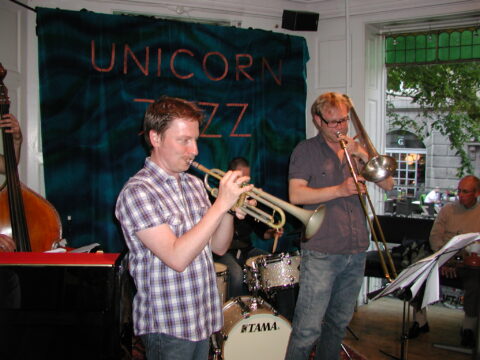
I just wanted to share a few tracks from a live concert in Copenhagen in June 2010. It´s with my quintet, featuring the amazing trumpet player Gerard Presencer. He decided to move to Copenhagen in 2009 to play with the Danish Radio Big Band, thank you for that, Gerard! Check out his solo in Coltrane´s 26-2, it is absolutely unnecessarily good…

The rest of the band consists of some of the best Danish jazz musicians, Henrik Gunde on piano, Thomas Fonnesbech on bass and Karsten Bagge on drums.

[mp3player width=400 height=80 config=player-in-post.xml playlist=alq-feat-presencer-live.xml]
read more »

Can you play a perfect crescendo in the middle/low range going from ppp to fff in one breath? This exercise is great to improve those skills!

But before you start playing the exercise in the sheet music gallery, please read the following:
The goal is not to play as strong as possible all the time! The goal is to get the feeling of opening up your throat and let the notes in ff pour out effortlessly.

The analogy of a water pouring out of a tap is a great way to visualize the air flow. Take a look at these three pictures: read more »

I know what you think: Yet another five minutes exercise that is supposed to change my life…
But no, this time you can actually settle with two or three minutes! And it really did make a big difference for me the first time I tried it, so I strongly recommend that you tried it out.

I got into some really bad problems with air flow a few years ago. After playing for years without thinking much about breathing with a natural talent for relaxed air flow I slowly got into trouble. It took me a very long time to get rid of the bad habits, both physically and mentally. This following exercise is one that really helped me. It is actually adapted from an excellent article about breathing problems (the Valsalva Maneuver) by Brad Howland.

I recommend that you stand up and make sure that you are relaxed and in good balance without your instrument. read more »