- The site about trombone playing!


How to improve your trombone playing with 5 minutes of theory (and a lot more practice…)
or
The only way to get to the next level of brass playing
or
Get that music-school-trombone-sound out of my life!!!
or
The truth about one of the worst and most common bad habits among brass players

Are you convinced that you continue reading this? Good, then let us get down to business! This post is about attack and tonguing for trombone players and ALL other brass players. This post is about how to discover one of the most common bad habits among brass players – and more important – how to get rid of it. read more »

Yet another flexibility exercise – seems to be that time of the year! These patterns show you some ways to get out of the first-down-to-seventh-position-playing-the-same-pattern-mode, making it more fun to play. This also makes your flexibility practicing come closer to the actual use of it in real music.

Many trombone (and other brass players) tend to do their flexibility home work, but as soon as they start moving the slide around, they put an attack on every note and cut up their airflow. Don´t go there! On of the benefits of flexibility exercises, is that it improves your legato playing – that is, if you actually use your flexibility skills. Both legato and flexibility should focus on constant air flow! read more »

Did you miss part 1 in this series? Read more here: Flexibility on trombone and mouthpiece – Part 1.

In this second part with exercises for both trombone and mouthpiece, the focus is on octaves and a mix of staccato and legato playing. The idea is to work on mouthpiece and trombone simultaneously to make sure that you use a similar embouchure. Beware of the pitch on the mouthpiece, especially when playing staccato phrases.

When a task is repeated over time, the muscle memory will be better and better at remembering how to do it, eventually allowing it to be performed without very much effort. This is important when playing on the mouthpiece since there is no tubing to “force” the lips to vibrate with the correct speed. You should combine this with using your ears to be able to hear the next pitch, before you play it.

By practicing the switch from mouthpiece to trombone, you will improve instrument control and your ability to hit the right pitch on the trombone.

The trick with playing on mouthpiece alone, is also to use the muscles at the side of the mouth where the lips meet, without creating tensions elsewhere in your body, disturbing the free air flow.

Good luck!


__________________________________________________________________________________


You will find this exercise and many others in the book Flexibility for Trombone – 38 pages in print friendly pdf format.

__________________________________________________________________________________

PS. Remember to sign up for the newsletter and get a free Jazz Etude! Find the sign up form at in the right column of the top of the page.

No secret for trombone and other brass players that practicing flexibility is one of the keys to good technique and chops! Playing the same exercise on both mouthpiece and instrument is great both for building up strength and gaining more control over the instrument.

Slightly re-inventing the wheel, I have made a bunch of trombone exercises that focus on playing both on the trombone and the mouthpiece. They are supposed to be played first on trombone and then on mouthpiece, but as a variation you could start with the mouthpiece. There will be some fiddling around with the mouthpiece on and off, but please bare with me on this one. read more »

Ask a trumpet player if he would rather play the lead part of Thad Jones´ ballad To You twice in a row, or have a sex change surgery! This tune is a great example on demanding static playing – lots of long, soft notes and few breaks to relax the lips.

When practicing a brass instrument, I make the distinction between static and dynamic exercises. Static exercices are based on long notes and slow legato lines with the lips constantly vibrating. This slowly build up lactic acid in the muscles controlling the lips, and make them stiff and numb. Dynamic exercices at the other hand, are built up around shorter notes, variation, staccato phrases and more space between the notes. read more »

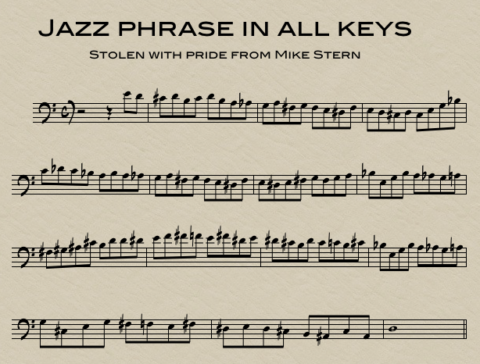
I stole this phrase from a Mike Stern recording a few years ago because I liked the sound of it. And bored on a rainy day, I decided to write it down in all keys and work on it on the trombone. It turned out to be a quite hard but rewarding technical trombone exercise. Try to play it as written, and you´ll get a good high range work out!

Enjoy…
read more »

I have written about the value of working with pedal tones before, but there is more to it! In these exercises, focus lays on including pedal tones when you work on flexibility on the trombone (or other brass instruments), and being able to access them effortless and without changing the embouchure to much compared to the normal range. read more »

Monday morning in the practice room? This is a great little exercise to get the chops going when you first pick up your horn that day. The key to all brass playing is in the air flow, and the key to a good air flow can often be found by working on a full, overtone rich sound in the medium to medium low range.

In this exercisee, I focus on F (below key hole-C) an augmented fourth down to B.* Many players have a hard time getting this register to sound as good as the rest of the middle range. One of the reasons is that the sound waves of the fifth in any given slide position doesn´t fit the instrument as goods as the fundamental on the same position (for example F versus Bb on 1st position). read more »

Practicing low range with a small mouthpiece
If you are working on the low range, consider doing the exercises you work on, on a smaller mouthpiece, or even on a smaller trombone if you play on a large bore tenor or bass trombone. Why? Well, playing a smaller mouthpiece makes it even more important to have the airflow centered in order to get the full sound. Big instruments and mouthpieces tend to be more forgiving if your embouchure and/or air flow isn´t dead on. You can test yourself: play a few notes in the low mid / low range in f on your large equipment. Now do the same with a smaller mouthpiece/trombone. Can you get the full sound out of it, or does it feels like it “locks up”? Of course, a big fff low E on a small bore horn with a 12C mouthpiece wont sound that great, but in general, you read more »

You might know the feeling, playing all those scale patterns one half tone up at the time… Seven keys to go ands the lips already feel as flexible as a train rail track!

There are lots of exercises where you gradually expand the range, and end up playing in either the extreme high or low register. I will give you a little but effective tip how to get the most out of those exercises, without busting your chops.

Expand from the middle
The solution is simple, make sure that you start in the middle range, and work your way both up and down from there. Mixing high and low range both save chops, and helps you to play with the same embouchure in all registers. This mouthpiece exercise works this way. read more »