- The site about trombone playing!

Did you miss part 1 in this series? Read more here: Flexibility on trombone and mouthpiece – Part 1.

In this second part with exercises for both trombone and mouthpiece, the focus is on octaves and a mix of staccato and legato playing. The idea is to work on mouthpiece and trombone simultaneously to make sure that you use a similar embouchure. Beware of the pitch on the mouthpiece, especially when playing staccato phrases.

When a task is repeated over time, the muscle memory will be better and better at remembering how to do it, eventually allowing it to be performed without very much effort. This is important when playing on the mouthpiece since there is no tubing to “force” the lips to vibrate with the correct speed. You should combine this with using your ears to be able to hear the next pitch, before you play it.

By practicing the switch from mouthpiece to trombone, you will improve instrument control and your ability to hit the right pitch on the trombone.

The trick with playing on mouthpiece alone, is also to use the muscles at the side of the mouth where the lips meet, without creating tensions elsewhere in your body, disturbing the free air flow.

Good luck!


__________________________________________________________________________________


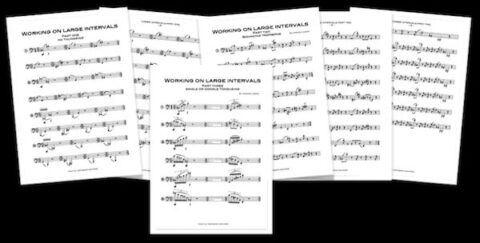
You will find this exercise and many others in the book Flexibility for Trombone – 38 pages in print friendly pdf format.

__________________________________________________________________________________

PS. Remember to sign up for the newsletter and get a free Jazz Etude! Find the sign up form at in the right column of the top of the page.

No secret for trombone and other brass players that practicing flexibility is one of the keys to good technique and chops! Playing the same exercise on both mouthpiece and instrument is great both for building up strength and gaining more control over the instrument.

Slightly re-inventing the wheel, I have made a bunch of trombone exercises that focus on playing both on the trombone and the mouthpiece. They are supposed to be played first on trombone and then on mouthpiece, but as a variation you could start with the mouthpiece. There will be some fiddling around with the mouthpiece on and off, but please bare with me on this one. read more »

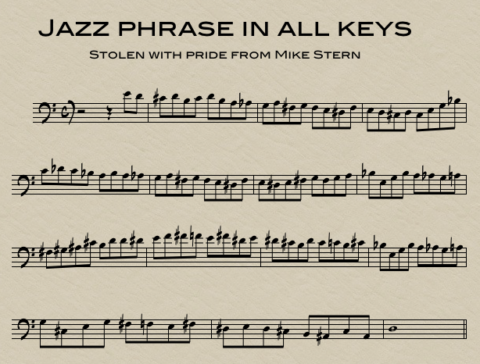
I stole this phrase from a Mike Stern recording a few years ago because I liked the sound of it. And bored on a rainy day, I decided to write it down in all keys and work on it on the trombone. It turned out to be a quite hard but rewarding technical trombone exercise. Try to play it as written, and you´ll get a good high range work out!

Enjoy…
read more »

Monday morning in the practice room? This is a great little exercise to get the chops going when you first pick up your horn that day. The key to all brass playing is in the air flow, and the key to a good air flow can often be found by working on a full, overtone rich sound in the medium to medium low range.

In this exercisee, I focus on F (below key hole-C) an augmented fourth down to B.* Many players have a hard time getting this register to sound as good as the rest of the middle range. One of the reasons is that the sound waves of the fifth in any given slide position doesn´t fit the instrument as goods as the fundamental on the same position (for example F versus Bb on 1st position). read more »

You might know the feeling, playing all those scale patterns one half tone up at the time… Seven keys to go ands the lips already feel as flexible as a train rail track!

There are lots of exercises where you gradually expand the range, and end up playing in either the extreme high or low register. I will give you a little but effective tip how to get the most out of those exercises, without busting your chops.

Expand from the middle
The solution is simple, make sure that you start in the middle range, and work your way both up and down from there. Mixing high and low range both save chops, and helps you to play with the same embouchure in all registers. This mouthpiece exercise works this way. read more »

Are you a jazz improviser? Do you know all the maj7 (major seven) and maj7#5 (major seven sharp five) patterns in all keys by heart? If not, I strongly recommend that you get started! They are extremely useful in when you improvise since they set the mood of a chord very clearly, and most of them are quite well suited for trombone as well.

The reason that I bring up the maj7 and the maj7#5 patterns at the same time, is because read more »

DOODLE TONGUING IN A JAZZ CONTEXT

In the previous articles in this series, I have talked about the fundamental of doodle tonguing, basic and advanced exercises. Doodle tongue is the perfect solution for all jazz trombone players who want to be able to play fast and precise legato lines.

This time I want to share some patterns and exercises that I have found to be very useful. This is stuff that I use a lot when I play improvised jazz solos. Let´s get started! read more »

BUILDING UP ON SPEED AND STRENGTH

Doodle tonguing is the perfect weapon for jazz trombone players who want to play fast and smooth melody lines. It is a technique for legato playing with built in swing phrasing!

Once you have the basics in place, and feel comfortable playing with doodle tongue, it is time to work on speed and strength. I use these exercises a lot, both to improving and maintaining my doodle skills. They are very useful, regardless if you just have begun mastering doodle tongue, or if you have been using the technique for centuries.

Use a metronome, and pick a tempo where you can play the exercises with great control and precision, and increase the tempo as you improve. Don´t to set the tempo too high! That might make you feel cool in the practice room, but you will sound bad on stage…

Playing these exercises is actually quite hard, and you will read more »

DOODLE TONGUING – BASIC EXERCISES
This is the second part of a series of articles about doodle tonguing, and this time I want to share a few basic exercises to improve both speed and precision when using doodle tongue.

I recommend that you take a few lessons with a doodling trombone player if you are new in this field to ensure that you get it right from the beginning. As usual, it is a lot easier to learn something the right way right away, rather than changing bad habits later!

The main use of doodle tongue is when you play fast legato lines, but to get there you should make sure that you can play it slow as well. The following exercises are all basic, and are designed to allow you to focus on getting the attacks perfect. read more »

INTRODUCTION TO DOODLE TONGUING

If you are a trombone player with some interest in jazz, chances are great that you heard about doodle tonguing. It is a technique that enables you to play fast lines much smoother than with double tongue (this is NOT double tongue for brass players!).

Playing fast lines on the trombone is actually more a question about articulation than being able to move slide fast enough. Since trombones don´t have keys or valves, we have to articulate different than other wind players, tonguing all the notes, possibly combined with natural legato where possible. read more »