- The site about trombone playing!


How to improve your trombone playing with 5 minutes of theory (and a lot more practice…)
or
The only way to get to the next level of brass playing
or
Get that music-school-trombone-sound out of my life!!!
or
The truth about one of the worst and most common bad habits among brass players

Are you convinced that you continue reading this? Good, then let us get down to business! This post is about attack and tonguing for trombone players and ALL other brass players. This post is about how to discover one of the most common bad habits among brass players – and more important – how to get rid of it. read more »

Did you miss part 1 in this series? Read more here: Flexibility on trombone and mouthpiece – Part 1.

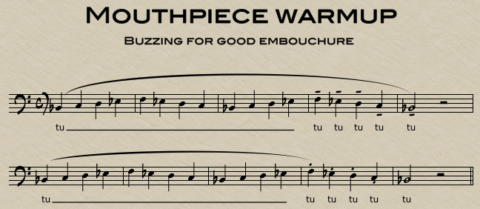
In this second part with exercises for both trombone and mouthpiece, the focus is on octaves and a mix of staccato and legato playing. The idea is to work on mouthpiece and trombone simultaneously to make sure that you use a similar embouchure. Beware of the pitch on the mouthpiece, especially when playing staccato phrases.

When a task is repeated over time, the muscle memory will be better and better at remembering how to do it, eventually allowing it to be performed without very much effort. This is important when playing on the mouthpiece since there is no tubing to “force” the lips to vibrate with the correct speed. You should combine this with using your ears to be able to hear the next pitch, before you play it.

By practicing the switch from mouthpiece to trombone, you will improve instrument control and your ability to hit the right pitch on the trombone.

The trick with playing on mouthpiece alone, is also to use the muscles at the side of the mouth where the lips meet, without creating tensions elsewhere in your body, disturbing the free air flow.

Good luck!


__________________________________________________________________________________


You will find this exercise and many others in the book Flexibility for Trombone – 38 pages in print friendly pdf format.

__________________________________________________________________________________

PS. Remember to sign up for the newsletter and get a free Jazz Etude! Find the sign up form at in the right column of the top of the page.

INTRODUCTION TO DOODLE TONGUING

If you are a trombone player with some interest in jazz, chances are great that you heard about doodle tonguing. It is a technique that enables you to play fast lines much smoother than with double tongue (this is NOT double tongue for brass players!).

Playing fast lines on the trombone is actually more a question about articulation than being able to move slide fast enough. Since trombones don´t have keys or valves, we have to articulate different than other wind players, tonguing all the notes, possibly combined with natural legato where possible. read more »

It was supposed to be a simple little exercise, didn´t expect it to end up covering nine pages of sheet music!

This is an exercise about the different types of triads and their inversions. Triads are a fundamental part of western music, both classical, jazz and pop/rock etc. You don´t need a bachelor in triadism to spot the difference between major and minor, but when you include the different inversion, mix minor, major, augmented and diminished it can be a bit more tricky to tell them apart. read more »

Nothing fancy here, just a great warm up exercise that I use on a (almost) daily basis. It´s a good combination of legato and staccato and starts in a relaxed range and goes down. Deep down! Try not to give up half way in order to get the most out of it. read more »